 HOME > News > Industry News > Are the dynamic and static standards of the batching scale the same? How should fertilizers be selec
 Update time : 2026-02-27 Publisher:Zhengzhou Hanke Machinery
The dynamic and static standards of the batching scale are quite different! When choosing a scale for fertilizer production, there are certain considerations.
The "dynamic" and "static" standards of the batching scale essentially represent a balance between accuracy and efficiency. Dynamic scales weigh during the material flow, affected by factors such as speed, impact, and belt slippage, with standard errors typically ranging from ±0.5% to 1%, making them suitable for continuous production; static scales allow for weighing of the material in a stationary state, with errors controlled within ±0.1%, but at a slower speed, making them suitable for high-precision scenarios.
Static batching scales allow for the static weighing of materials on the scale, without continuous operation, and the standards place more emphasis on the accuracy of a single weighing, making them suitable for scenarios with strict ratio requirements; dynamic batching scales allow for weighing during the material transportation, with standards focusing more on the stability and cumulative accuracy of continuous operation, while also balancing efficiency and error control.
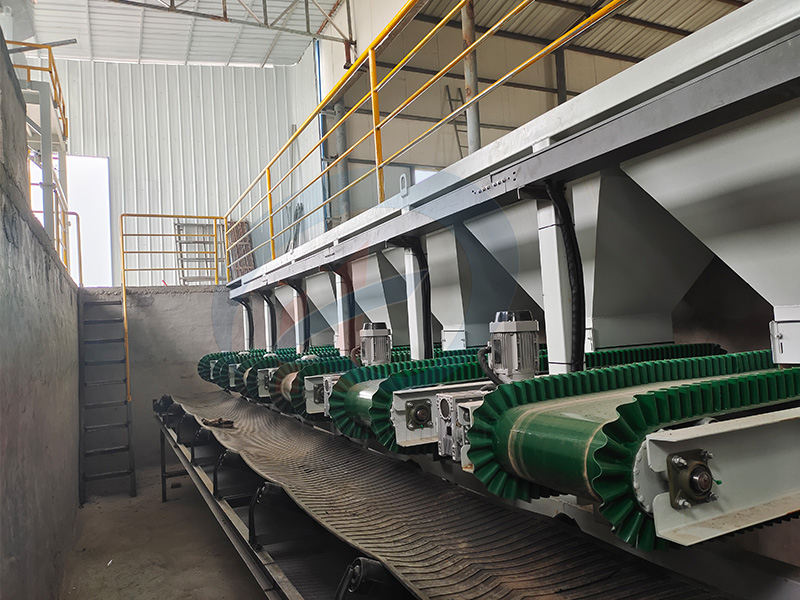
Take fertilizer production as an example:
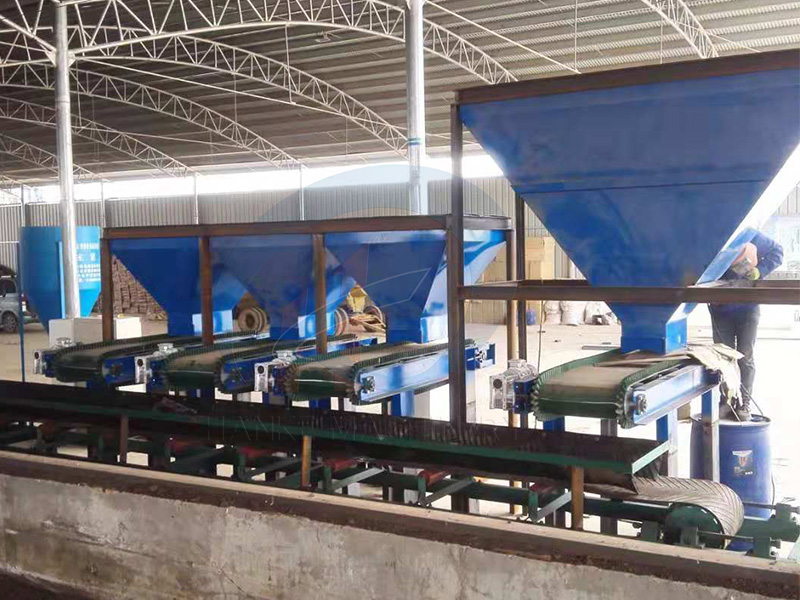
Compound fertilizers (such as nitrogen-phosphorus-potassium compound fertilizers): Static scales must be selected! Zhengzhou Hanke Machinery once designed a static batching system for a certain compound fertilizer enterprise. Each raw material bin has an independent static weighing hopper, and through "fast-slow" two-level feeding, the material is quickly discharged to 90% and then precisely replenished slowly. This design completely avoids the error accumulation caused by the impact of the material on the dynamic scale, ensuring that the total nutrient content of each batch of fertilizer is completely consistent with the formula. If using a dynamic scale, potassium fertilizer (such as sulfuric acid potassium) due to its strong fluidity and high specific gravity, the error may be amplified to ±2%, directly leading to product non-compliance.
Single raw material quantitative feeding (such as coal powder): Dynamic scales are more efficient. Zhengzhou Hanke also provides dynamic scale solutions, through real-time monitoring of flow and adjusting the feeding speed, achieving continuous production, suitable for the pre-mixing process with low precision requirements.
The key to choosing a scale lies in three points: the complexity of the formula, the characteristics of the raw materials, and the production scale. The more complex the formula and the greater the differences in raw materials (such as fluidity, hygroscopicity), the more obvious the "batch consistency" advantage of the static scale; if only a single raw material is quantitatively fed, dynamic scales' "continuity" is more cost-effective.
Want fertilizer production to be both stable and accurate? Zhengzhou Hanke Machinery has accumulated many years of experience in batching scale technology, whether it is dynamic continuous flow operation or static precise measurement, there are mature solutions. Want to know which one is more suitable for your specific formula and production capacity? Come and talk with us, and we can help you save this "confusing money".
see details +
see details +
see details +
see details +

 Tel:+86 17319777703
 E-mail:hkautomaticpack@foxmail.com
 Address:Xingyang City, Zhengzhou City, Henan Province.


Privacy Policy Copyright © Zhengzhou Hanke Machinery Equipment Co., Ltd Co., Ltd.





 Mobile/Whatsapp
 E-Mail